I am an Assistant Professor at the College of Artificial Intelligence, Shenzhen University, where I lead MUSE Lab (Multimodal Understanding and Synthesis for Explainability). I received my Ph.D. in Computer Science from Fudan University in 2025, advised by Prof. Junping Zhang, and my B.S. in Physics from Fudan University in 2019. I am a member of the Technical Committee on Hybrid Intelligence and the Science Popularization Committee of the Chinese Association of Automation (CAA).
我是深圳大学人工智能学院助理教授、硕士生导师,负责 MUSE Lab(Multimodal Understanding and Synthesis for Explainability Lab)。2025 年博士毕业于复旦大学计算机科学技术专业,师从张军平教授;2019 年本科毕业于复旦大学物理学专业。现为中国自动化学会混合智能专委会、普及工作专委会会员。
My research aims to make generative AI controllable, interpretable, and trustworthy. I study why text-to-image diffusion models succeed or fail on specific concepts and how to edit images and videos precisely and consistently; how large language models and agents stay reliable — free of hallucination, bias, and state collapse — over long-horizon interaction; and how generative agents can perceive and express human emotion. I am also interested in bringing these models to real-world applications such as emotional companionship, virtual try-on, and digital humans.
我的研究目标是让生成式 AI 更加可控、可解释、可信:研究文生图扩散模型为何在特定概念上成功或失败,以及如何实现精确、一致的图像与视频编辑;研究大语言模型与智能体如何在长程交互中保持可靠,避免幻觉、偏见与状态崩塌;研究生成式智能体如何感知并表达人类情感。同时探索这些技术在情感陪伴、虚拟试衣、数字人等真实场景中的落地应用。
2026.08 🎉🎉 Three papers accepted to EMNLP 2026.三篇论文被 EMNLP 2026 接收。
2026.07 🎉🎉 One paper accepted to ACM MM 2026.一篇论文被 ACM MM 2026 接收。
2025.04 🏫 Joined the College of Artificial Intelligence, Shenzhen University as an Assistant Professor.加入深圳大学人工智能学院,任助理教授、硕士生导师。
2025.04 🎉🎉 One paper published in IEEE/CAA Journal of Automatica Sinica, with code.一篇论文发表于 IEEE/CAA Journal of Automatica Sinica,代码已开源。
2025.03 🎓 Received my Ph.D. from the School of Computer Science and Technology, Fudan University, advised by Prof. Junping Zhang.于复旦大学计算机科学技术学院博士毕业,导师张军平教授。
Research研究方向
MUSE LabMultimodal Understanding and Synthesis for Explainability
My group works on AIGC, multimodal understanding and generation, large language models, retrieval-augmented generation, persona-based language modeling, and emotional agents.
Why do diffusion models fail on specific concepts, and how can we edit images and videos precisely while keeping semantics consistent and identities intact?
Keeping LLMs and agents reliable: constraint and state integrity in long-horizon dialogue and agent handoffs, reflective search for code generation, and AI-for-AI systems that write academic surveys.
让大模型与智能体更可靠:长程对话与多智能体交接中的约束与状态保持、面向代码生成的反思式搜索,以及自动撰写学术综述的 AI for AI 系统。
From facial expression and micro-expression analysis to emotional agents that understand and respond to people, extending toward embodied AI and world models.
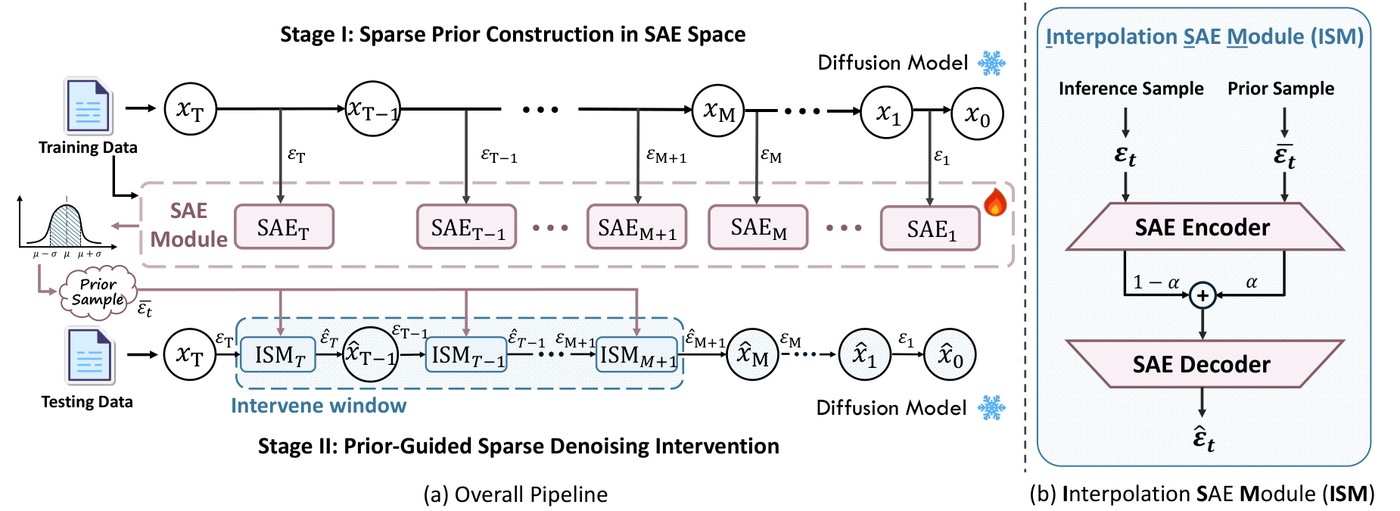
Text-to-image diffusion models usually follow prompts well, yet we found an overlooked failure: a concept such as “ink sketch” works for most objects but fails again and again on a few — Flux draws grapes as an ink sketch but keeps painting a cake in full color. These failures persist across random seeds, revealing systematic blind spots in how the model has learned the concept rather than sampling noise. We train sparse autoencoders at every denoising step, compare successful and failed generations in this sparse space where concepts become separable, locate the missing or weakened concept dimensions, and repair them at inference time by nudging features toward a concept prototype built from reliable samples, with no retraining. Across multiple diffusion backbones this markedly improves concept consistency, text fidelity and repair success, and the earlier the intervention, the stronger the correction.
When LLMs Forget What They Believe: Characterizing State Integrity Collapse in Long-Horizon Dialogues
Yancheng Zhu, Yifan Yuan†
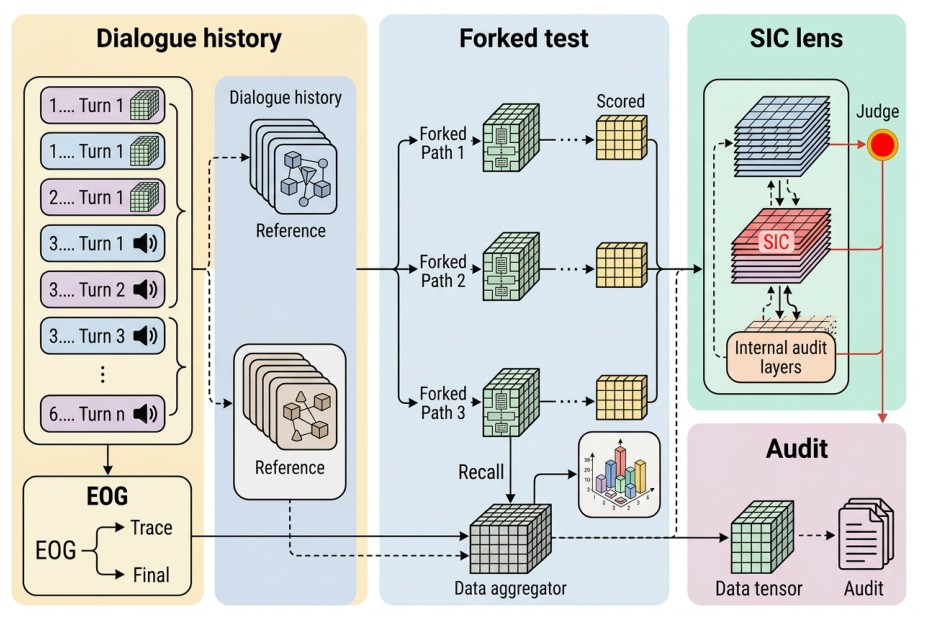
Assistants must keep obeying user-set constraints — formats, personas, safety boundaries — over many turns, but evaluations mostly test instruction following in a single turn or a short exchange. We identify a subtle but dangerous failure, State Integrity Collapse: asked about it, the model can still restate the constraint, yet its next answers stop following it — unlike ordinary forgetting, this is not fixed by longer context or memory retrieval. We build StateTrack-Bench, which plants one persistent constraint (numerical, format, persona, factual-memory or logical) in a conversation, checks compliance at increasing dialogue depths, and uses a forked recall audit to tell forgetting apart from remembering without complying. Across seven models, 88.6% of failures are such behavioral drift rather than forgetting, and our Structured State Anchoring recovers up to 24.4 points.
ReMCTS: Reflection-Enhanced Monte Carlo Tree Search for Code Generation
Wang Huifei, Huang Xinying, Sun Yiheng, Yifan Yuan†
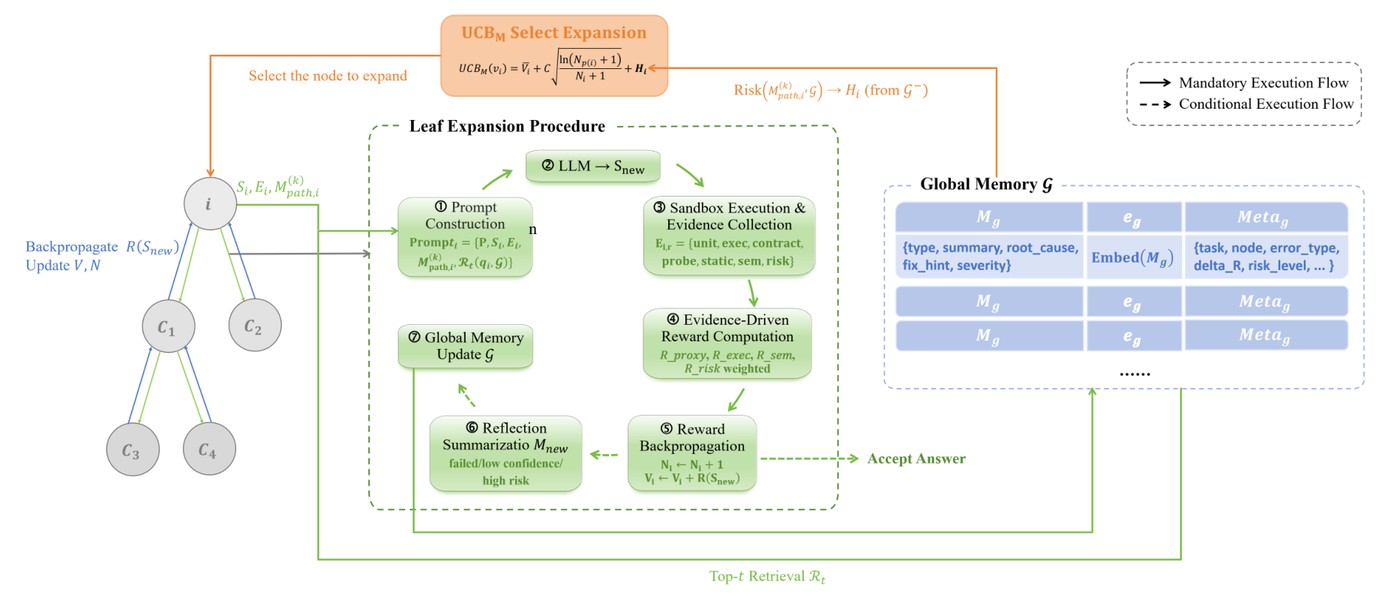
Code written by large language models often looks right yet fails on edge cases and hidden tests, and common self-repair keeps patching a single attempt, so an early wrong algorithmic choice is hard to escape. Existing tree-search methods rank candidates with numeric rewards but do not share the textual diagnoses of failures across branches, and without tests they may mistake missing evidence for success. ReMCTS organizes candidate programs as a search tree, runs them in a sandbox for feedback, keeps each branch's debugging context, stores failure diagnoses in a shared memory that other branches retrieve, and tells failed checks apart from missing evidence. On HumanEval and MBPP it beats direct generation in 8 of 10 model–dataset pairs, and ablations show where the gains come from and where they stop.
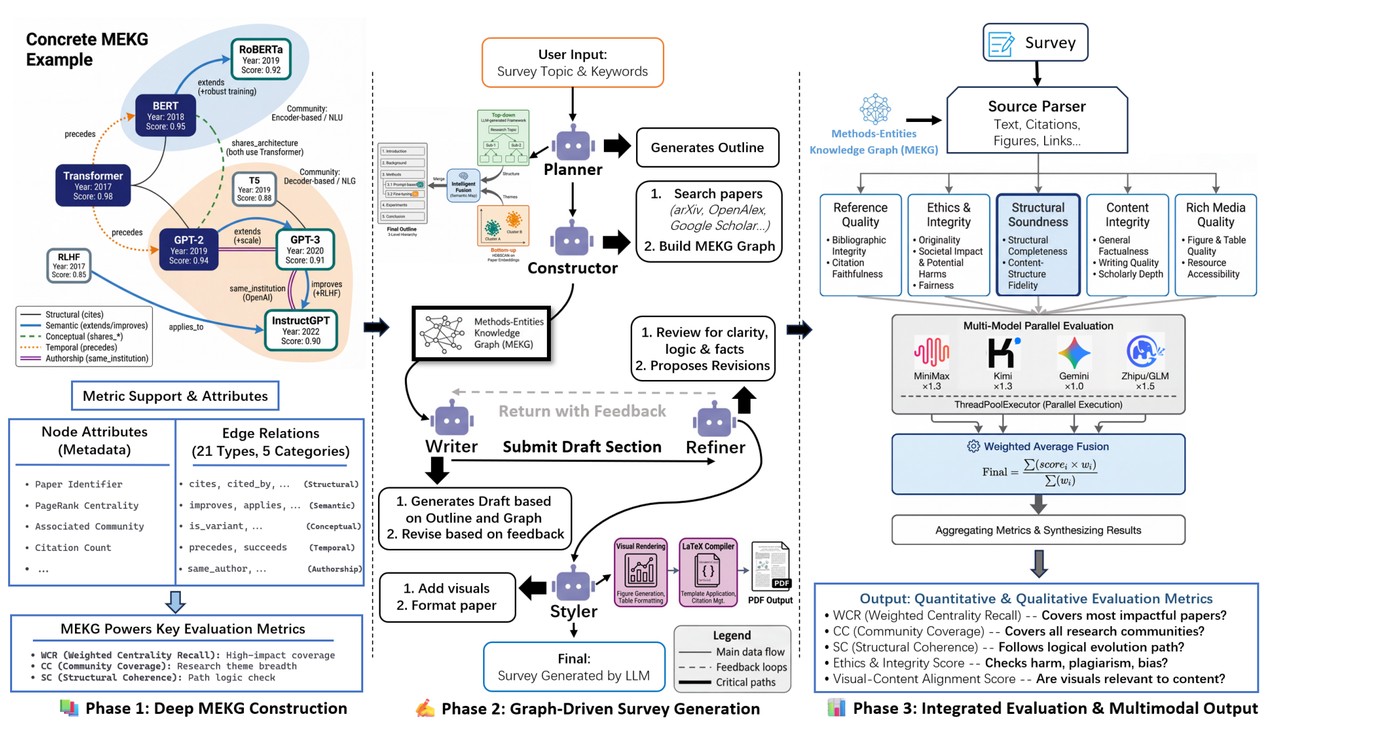
Publications are growing so fast that writing a good survey is ever more costly, and current LLM survey generators mostly retrieve papers as a flat pile of independent documents. A good survey explains how a field evolved — which work extends which, which methods compete, which benchmarks mark turning points — structure that similarity-based retrieval cannot see, so generated surveys read like a collage of summaries. SurveyGraph builds a Methods-Entity Knowledge Graph that records follow-on, competition and shared-resource relations between methods, and uses it as the backbone for core-paper discovery, graph-aware retrieval, outline generation and evolution-aware writing. Graph-aware retrieval nearly doubles recall over flat lexical baselines (p = 0.004), and citation audits find that 80.6% of generated sentences are fully or partly supported by the papers they cite.
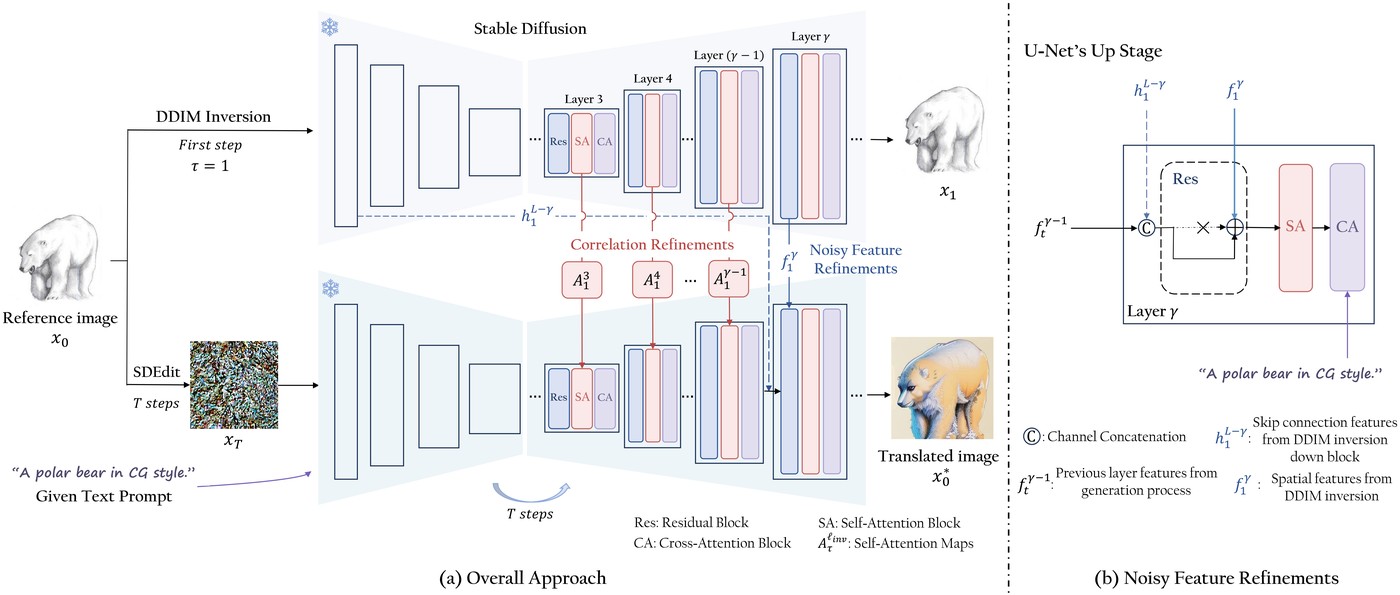
Dissecting and Mitigating Semantic Discrepancy in Stable Diffusion for Image-to-Image Translation
Yifan Yuan, Guanqun Yang, James Z. Wang, Hui Zhang, Hongming Shan, Feiyue Wang†, Junping Zhang
When a text-to-image diffusion model is used for image-to-image translation — turning a photo into a painting, say — everything hinges on an initial noise that keeps the original image's information, and the common choice, SDEdit, simply adds random noise to the image. We find that this causes “semantic discrepancy”: the model misreads relations in the image and invents content that was never there, because the noise breaks the image's semantic integrity and makes U-Net upsampling link unrelated regions. We propose a training-free, plug-and-play fix for Stable Diffusion that exploits the determinism of DDIM inversion: a single inversion step of the reference image supplies accurate features and correlations, which replace the faulty ones in generation. Across translation tasks on COCO, ImageNet and ImageNet-R, it reduces semantic discrepancy and improves fidelity, outperforming PnP and similar methods with fewer priors while running 11.2× faster.
EMNLP 2026When LLMs Forget What They Believe: Characterizing State Integrity Collapse in Long-Horizon Dialogues Yancheng Zhu, Yifan Yuan†.[Paper][Code]
EMNLP 2026ReMCTS: Reflection-Enhanced Monte Carlo Tree Search for Code Generation Wang Huifei, Huang Xinying, Sun Yiheng, Yifan Yuan†.[Paper][Code]
IEEE/CAA JAS 2025Dissecting and Mitigating Semantic Discrepancy in Stable Diffusion for Image-to-Image Translation Yifan Yuan, Guanqun Yang, James Z. Wang, Hui Zhang, Hongming Shan, Feiyue Wang†, Junping Zhang. IEEE/CAA Journal of Automatica Sinica, 2025, 12(4): 705–718.JCR Q1 · IF 19.3[Paper][Code]
ICASSP 2023DO-FAM: Disentangled Non-Linear Latent Navigation for Facial Attribute Manipulation Yifan Yuan*, Siteng Ma*, Hongming Shan, Junping Zhang. IEEE International Conference on Acoustics, Speech and Signal Processing (ICASSP), 2023.[Paper]
ICASSP 2022VR-FAM: Variance-Reduced Encoder with Nonlinear Transformation for Facial Attribute Manipulation Yifan Yuan, Siteng Ma, Junping Zhang. IEEE International Conference on Acoustics, Speech and Signal Processing (ICASSP), 2022: 1755–1759.[Paper]
Book Chapter 2023High-Speed Joint Learning of Action Units and Facial Expressions Feng Xu, Yifan Yuan, Junping Zhang, James Z. Wang. Chapter 7 in Modeling Visual Aesthetics, Emotion, and Artistic Style, Springer, 2023.[Paper]
Book Chapter 2023ExpressionFlow: A Microexpression Descriptor for Efficient Recognition Feng Xu, Yifan Yuan, Junping Zhang, James Z. Wang. Chapter 8 in Modeling Visual Aesthetics, Emotion, and Artistic Style, Springer, 2023.[Paper]
JIG 2020Spatiotemporal Attention Network for Microexpression Recognition Guohao Li, Yifan Yuan, Xianye Ben, Junping Zhang. Journal of Image and Graphics (中国图象图形学报), 2020, 25(11): 2380–2390.[Paper]
Fudan University复旦大学 2019.09 – 2025.03 Ph.D. in Computer Science and Technology, advised by Prof. Junping Zhang计算机科学技术 理学博士,导师:张军平教授
Fudan University复旦大学 2015.09 – 2019.06 B.S. in Physics物理学 理学学士
Research Grants科研项目
PI主持Reliability Evaluation and Controllable Editing Mechanisms for Generative Image Editing生成式图像编辑的可靠性评估与可控编辑机制研究 Shenzhen University Research Start-up Fund for Young Faculty深圳大学青年教师科研启动经费 · 2025.08 – 2028.08
Main Participant主要参与人Embodied-Intelligence Foundation Models for Industrial Humanoid Robots人形机器人工业具身智能基座大模型与垂直领域示范应用 Shenzhen Key Industry R&D Program深圳市重点产业研发计划 · 2025.10 – 2028.09
Lead Researcher主要负责人Intelligent Models for Multimodal Information Retrieval, Review and Moderation多模态信息检索、审查与管控智能模型研究 Industry project with China Mobile横向项目,中国移动 · 2025.06 – 2026.12
Participant参与AI Virtual Patients for Clinical Teaching in Gastroenterology面向消化科临床教学的AI虚拟病人技术研究与应用 Guangdong Natural Science Foundation, General Program广东省自然科学基金面上项目 · 2026.01 – 2028.12
Participant参与Deep Learning Based on Graph Convolutional Networks and Disentangled Learning基于图卷积神经网络和解耦学习的深度学习研究 National Natural Science Foundation of China, General Program国家自然科学基金面上项目 · 2022.01 – 2025.12
Participant参与Key Theories and Technologies of Human–Robot Collaboration Based on Imitation Learning from Demonstration基于示教模仿学习的人机协同关键理论与技术 National Key R&D Program of China, No. 2018YFB1305104国家重点研发计划(十三五),项目编号 2018YFB1305104 · 2019.06 – 2022.05
Earlier projects (6, as participant): NSFC, Ministry of Education, Shanghai Municipality, and industry, 2017–2025此前参与的项目(6 项):国家自然科学基金、教育部、上海市及企业合作项目,2017–2025
Machine-Learning-Based Multimodal, Multi-View Pedestrian Gait Recognition基于机器学习的多模态多视角行人步态识别研究 National Natural Science Foundation of China, No. 61673118国家自然科学基金,项目编号 61673118 · 2017.01 – 2020.12
Planning Research on Human–Machine Collaborative Hybrid-Augmented Intelligence Algorithms人机协同混合增强智能算法规划研究 Ministry of Education project教育部项目 · 2020.01 – 2021.12
Automatic Correction of Numerical Simulation Errors Based on Big-Data Deep Learning基于大数据深度学习的数值模拟误差自动订正技术 Shanghai Science and Technology Innovation Action Plan, No. 18DZ1200404上海市科技创新行动计划,项目编号 18DZ1200404 · 2018.04 – 2021.03
Machine-Learning-Based Heavy Precipitation Forecasting基于机器学习的强降水预报技术开发项目 Industry project with Shanghai Central Meteorological Observatory横向项目,上海市中心气象台 · 2020.03 – 2021.04
Mid- and Long-Form AI Popular-Science Videos for Teenagers面向青少年的人工智能科普中长视频的制作与推广 Shanghai Science and Technology Innovation Action Plan, Popular Science Program上海市2024年度“科技创新行动计划”科普专项项目 · 2024.09 – 2025.08
Short-Video Science Communication on Frontier Advances and Applications of AI人工智能前沿进展与应用的短视频科普 Shanghai Science and Technology Innovation Action Plan, Popular Science Program上海市2021年度“科技创新行动计划”科普专项项目 · 2021.06 – 2023.06
Journal reviewer: IEEE Transactions on Multimedia (TMM)期刊审稿人:IEEE Transactions on Multimedia(TMM)
Membership: Technical Committee on Hybrid Intelligence and Science Popularization Committee, Chinese Association of Automation (CAA)学会会员:中国自动化学会混合智能专委会、普及工作专委会